Mary Morgan Voice Artist Branding Logo

Mary Morgan

  • Home
  • Demos
  • About
  • Videos
  • Testimonials
  • Clients
  • Vocalist
  • Blog
  • Contact

Hard Work

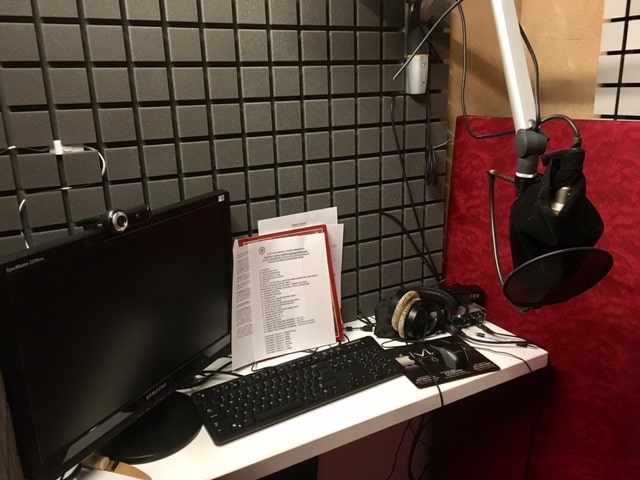
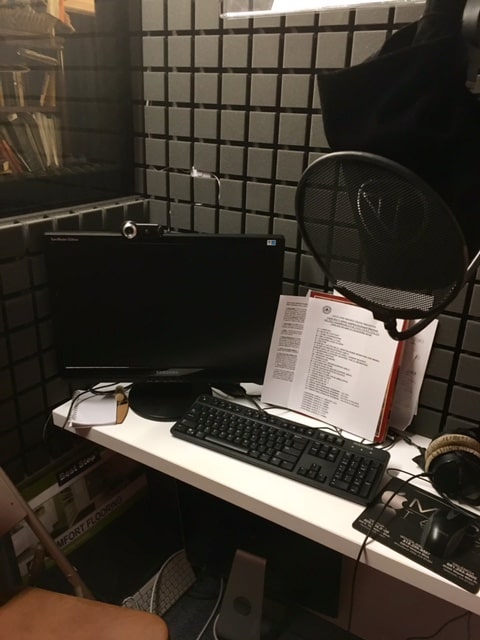
Voice Over Life: Building My StudioBricks Booth part 1

January 22, 2022 by MaryMorgan

Alright folks, many, many people have been asking for this and it’s finally here: my StudioBricks booth.

Expect quite a few pictures!

You can find another post about why I chose StudioBricks over other sound booth products on my blog.

For this post, I’m discussing the process of putting it together in a two-part series.

Ready?

Warning: I am NOT a sound professional. Everything in this post and the next one are based on lots and lots and LOTS of research as well as input from colleagues and professionals in audio.

Ok, when I ordered my StudioBricks booth I was very careful to choose a triple-wall studio pro. So, to begin, I analyzed the most quiet space in my house or apartment.

Was there lots of traffic outside? Lawnmowers? Planes flying overhead? Those are situations that can’t be controlled, unfortunately, so now and then I’ll just have to wait them out. Thankfully most are distant and occasional; however, it did no good treating my space for recording because of a 60 Hz hum in my walls, which is common in older houses. It interfered heavily with my recordings, and was very difficult to edit. Over time the hum increased and I got tired of seeing my wave files distorted. That led me to the decision to get a sound booth.

While some clients are ok with booths, some are not and have expressed frustration with editing audio from sound booths. I’ve determined that if my space still isn’t good enough for a client then I’ll have to go to a professional studio. So far, I don’t think that’ll be the case.

After choosing my area I had to measure where I’d build the booth and be super precise with what I wanted. The ceiling height is important in this as well when putting the booth together, literally piece by piece. If too low it would be a problem. Thankfully my room has a slanted ceiling which I’ve been told is a good thing. I ordered a 5 x 6 x 7 foot booth in size with the purpose of having a good amount of space to stand, sit, or move. Experts in audio told me NOT to get a booth that was squared, so I went with something more rectangular. When I sought advice from fellow VO talent who also owned a StudioBricks most suggested a triple wall to be safe. As since I can’t predict where I’ll be in the future (new house in the suburbs, new apartment in a busy part of town, etc.) I decided to get the triple wall.

I sent in my order feeling good about my decision and waited 3 months for delivery. Originally it was suggested the time frame would only be 2 months. However, when it came time to ship the goods from Spain, the port dock workers had gone on strike and thus delayed my order for another month.

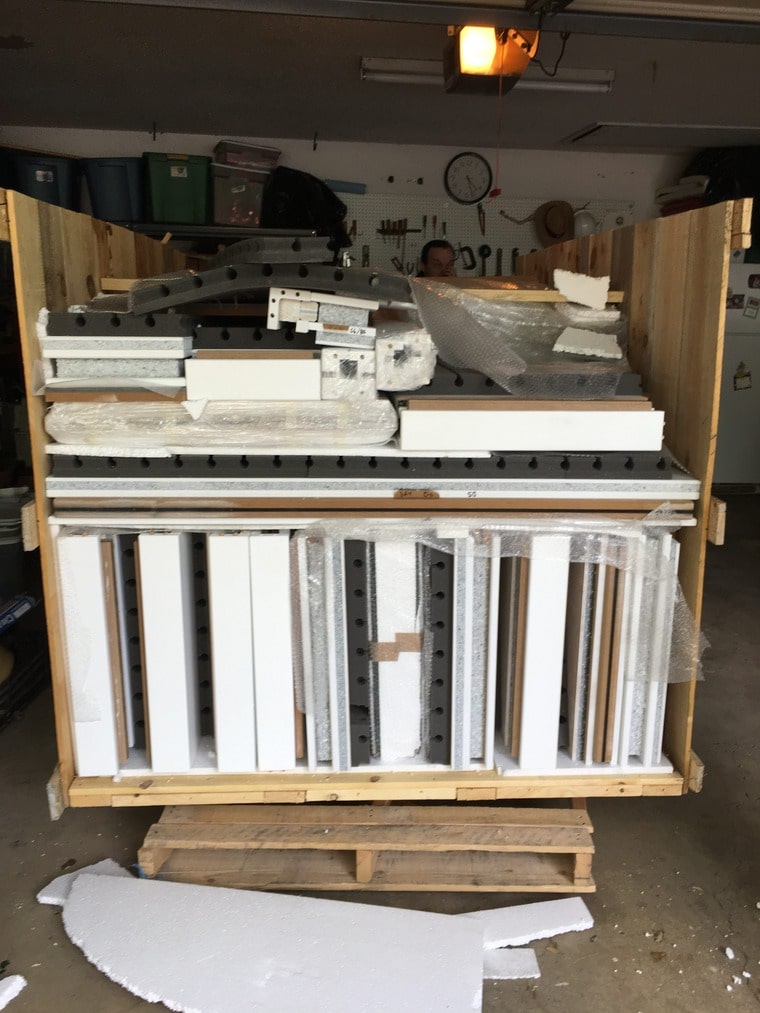
During a vacation to Lake Tahoe with my boyfriend, I received news that the booth had arrived at my house in a massive crate the size of a van. Here’s a picture to prove it.
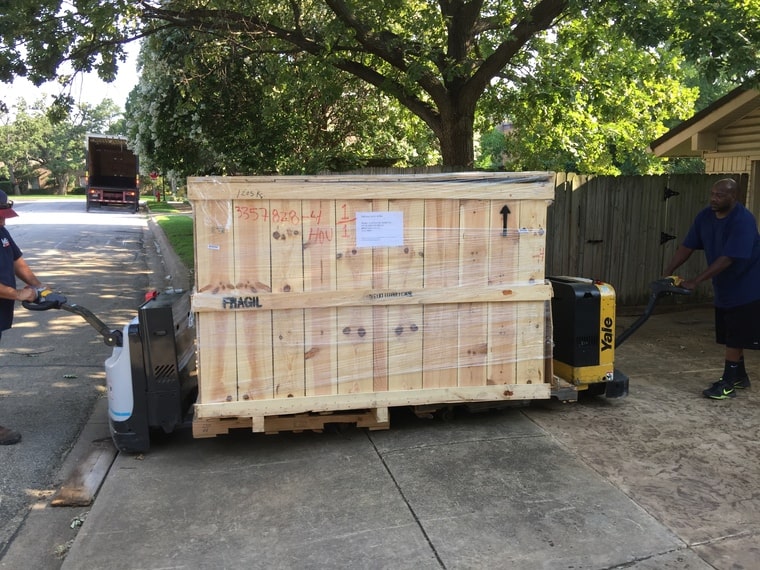
I was prepared for this monster of a box and had planned weeks ahead to have the garage cleared out so we could store it in a safe place. After getting home and adjusting back to my routine, it was time to put it together.
My brother and my boyfriend were my helpers in this for the first round (that’s right, I’ll explain later).

My brother determined that my chosen space wasn’t adequate due to the ceiling height. So, we chose a different side where the slanted ceiling went upwards. Boy was that a WISE idea!

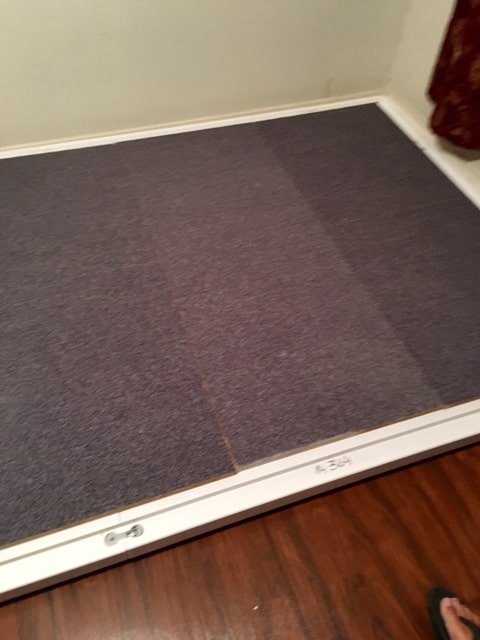
Next was the first phase: The floor

I have wooden floors instead of carpet so I had no need for holders. The booth came with adjustable feet to hold the outer frame together. So, we put together the outer layers so as to put the floor boards on top of them. That’s when the excitement came along of how easy it was to place everything together.
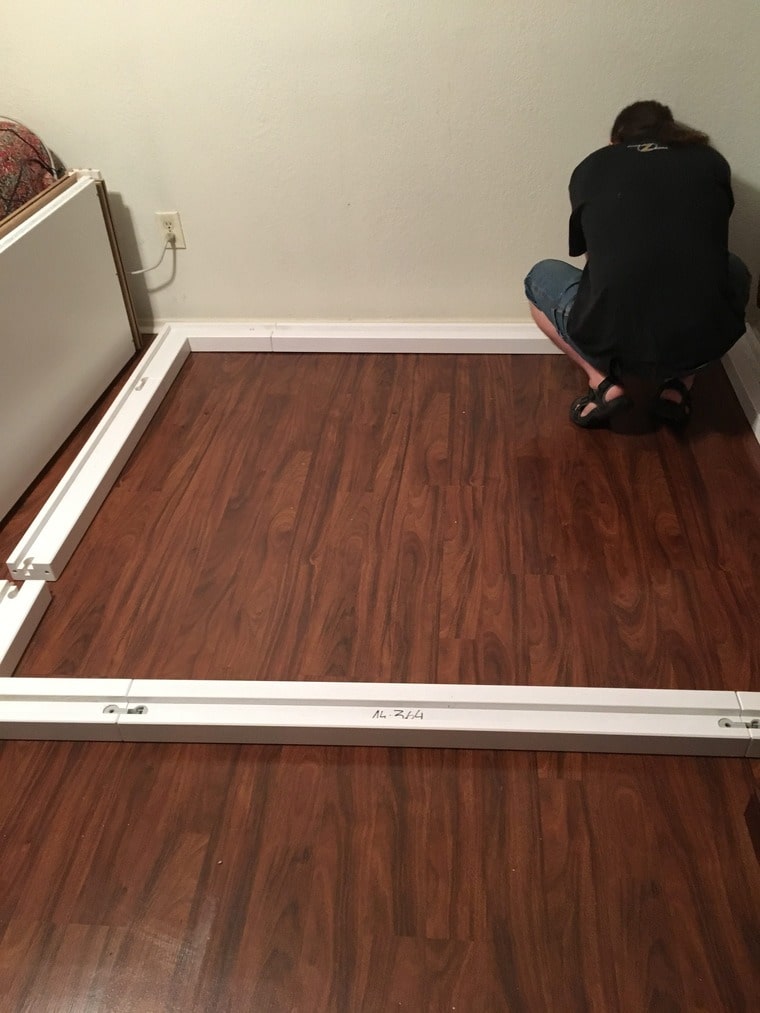
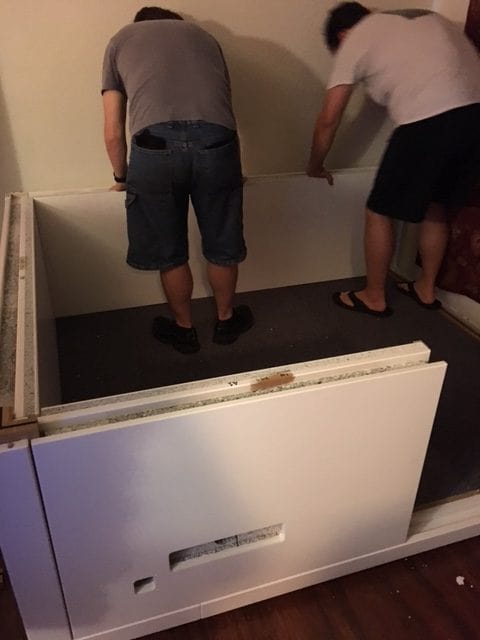
The bottom section of the booth was marked with letters and numbers: the A section, the B section, the C section and the D section. We began with putting A1 through A5 on first. There was no need for screws or nails. The pieces fit like giant Legos (but are called bricks) and held together by use of wooden staffs in corners and in between spaces on top so that other pieces could fit on top of them. It took the gentle use of a rubber mallet to ensure the staffs were fitted in place. Then came the B section, which we assembled by repeating the same process for the A section.

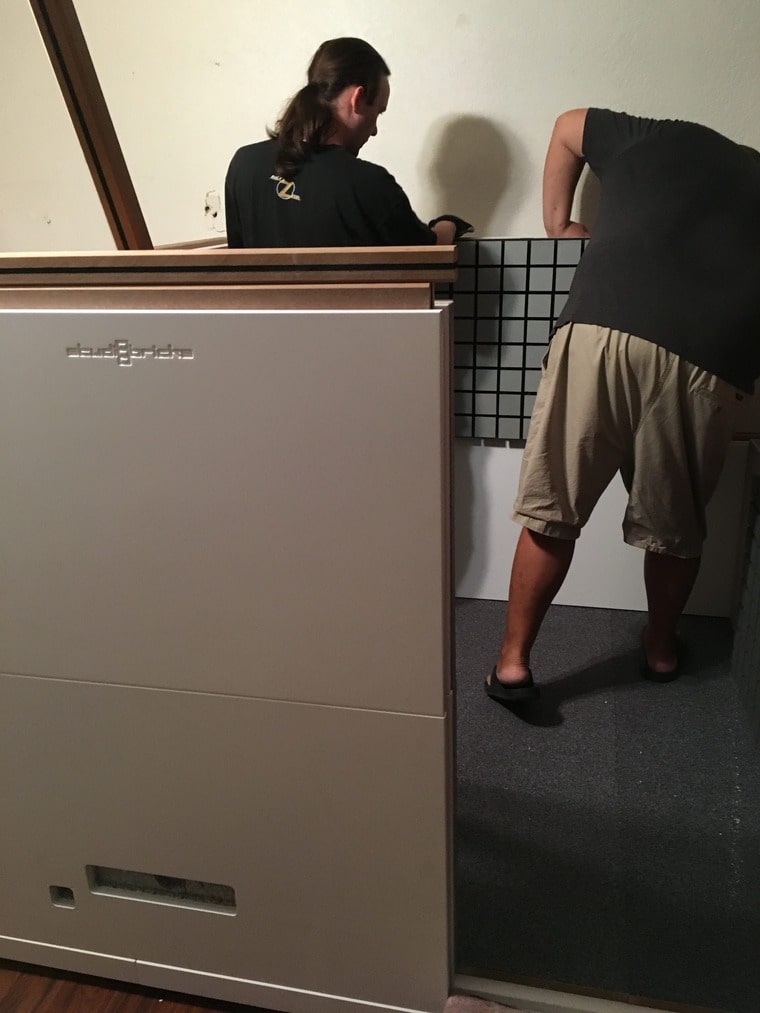
After that came the part that everyone owner of a StudioBricks booth warned me about: The dreaded door. Some of my colleagues have glass doors, but I chose to have a wooden door. Whichever one you go with know this: it will be HEAVY! Do NOT handle this piece on your own, mine weighed 175 pounds. It took my brother, my boyfriend, my father and me to get it out of the crate, then carried into the house, to my room, and finally to secure it onto the booth. At that moment, I realized what a blessing it was to live in a one-story house. And if I ever decide to get an apartment, it’ll have to be on the first floor.

With the door in place it was time to add the sections marked with letter C and how many pieces came with it.

Then, we discovered that there weren’t enough wooden beams to keep the C pieces locked in place. That delayed building the rest of the booth for a week in a half.

The folks at StudioBricks were extremely helpful and rushed not one but two extra wooden beams just in case.

When they arrived my brother and my boyfriend added the final section marked as D which was mainly the top walls and ceiling parts. By this time the worst was out of the way, meaning the leftover pieces weren’t as heavy.

So, depending on your strength, expect most pieces to have dense structure. It’s not recommended whatsoever to put this together on your own.

Once done. It looked MARVELOUS! As you can imagine, I couldn’t wait to get in there to record samples and auditions.

However… something was wrong. And because of this detail, we had to take it apart piece by piece and put the entire thing back together again!!!!!!!!

To find out what was wrong and how we fixed it, stay tuned for part 2!

Filed Under: Voice Over Tagged With: booth, building, Commitment, Hard Work, heavy, home recording, home studio, house, ideas, professional, recording, recording space, recording studio, sections, soundbooth, studio, StudioBricks, VO, Voice Acting, voice actor, voice actress, voice artist, Voice Over, voice over artist, voice over career, voice over studio, voice over talent, voice over website, work

Voice Over Life: Building My StudioBricks Booth part 2

January 21, 2022 by MaryMorgan

Continuing from my last post with Part 2 of putting my StudioBricks booth together. If you haven’t read it yet, I suggest doing so to keep up with what I’m sharing here.

I had put my studio together with the help of my brother, my boyfriend and my Dad. It looked amazing and was quite cozy inside. However, after all the unloading, and putting it together one section at a time (which took maybe 3 hours), there was a problem.

The floor was creaking.

Each time I stepped in or moved my feet around, the wooden boards on the outer floor frame made slight scraping sounds that I knew would interfere with recording and be a pain to edit out. After speaking with the great folks at StudioBricks and my good friend Jerry Pelletier, who was instrumental in helping me understand the fine points of how to assemble it, we realized the floor was uneven. Now, foot holders came with the package and were easy to adjust. Unfortunately, we neglected to measure each area to make sure the sides were even. There was only one solution to treat the problem: Taking it apart piece by piece and starting all over again.

For this round, my boyfriend and two of our friends helped. We started from the ceiling, and took the whole thing apart from top to bottom. Once we got to the floor we spent 30-45 minutes making sure the feet were adjusted accordingly, and that each side was even. Then, we added foam beneath the floor boards. It’s not necessary to use expensive Auralex foam. We used cheap bedding foam from Walmart. We had to apply something heavy for the middle board for a while since it kept trying to pop up. But now it no longer needs pressure to keep it down. We walked on it several times to make sure the creaking was gone. I can occasionally hear a tiny scrape when stepping inside, but it doesn’t stick around. Now I can sit, stand and move without worry that noises will interfere with recordings.

We assembled each section yet again, starting from sections label A1 to A5, then B1 to B5, then C1 and C5 and onward.

Despite how exhausting the process was of putting it together, then taking it apart and building it back up, it was totally worth it!! I love going inside to record now. I don’t hear planes flying overhead, I don’t hear the 60 hz hum in the walls and I don’t hear my PC.

Some tidbits worth sharing about my experience thus far:

-I specifically asked the manufacturers not to include the aeropack fan. They assured me that it’s silent. However, it’s really not. Even still, they sent the fan anyway, free of charge. I don’t use it.

-The subject of airflow in the booth is an important discussion. At the moment, I have nothing filtering air outside in. It’s a process still in the works.

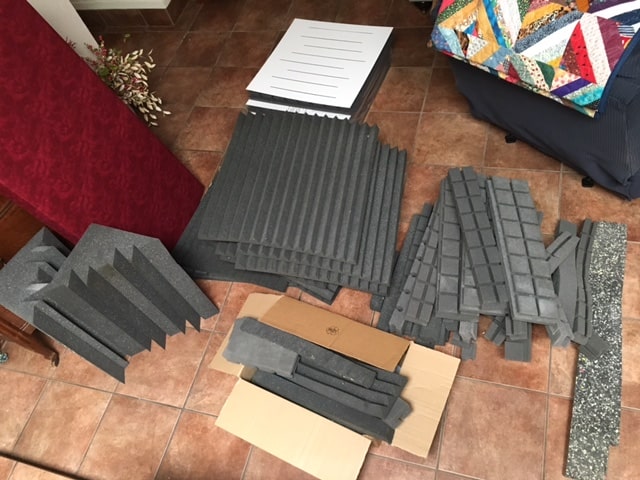
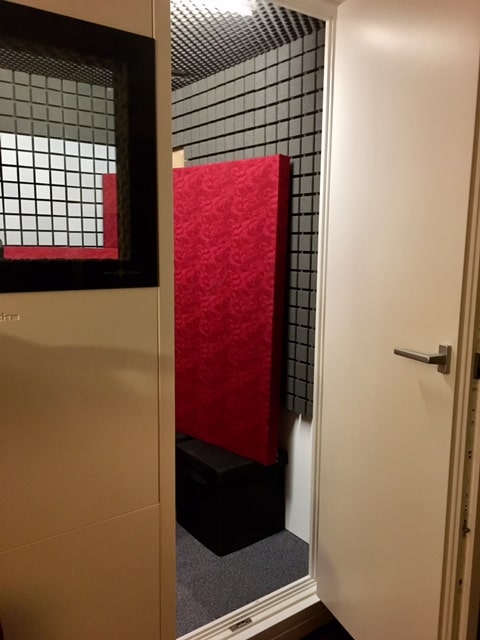
-I didn’t use all the foam that the booth came with, not even the bass traps. In fact, most of that stuff is in my closet. Quite a few people said to use the bass traps on the corners, but because they’re solid foam, I worry that they’ll make me sound boxed in with the foam already built on the walls. So, for the time being I have sound panels positioned around me, which I made with compressed fiberglass boards wrapped in calico cloth from a fabric store. I’d like to have one positioned above my head on the ceiling, as I’m not crazy about the egg shell foam above my head.

-I don’t like the desk that came with booth because when I sit to record and brush against the edge of the table it rattles a bit. It’s left in there for now, until I can find something better. I recommend a wooden table with wobble-proof legs.

-The window is left uncovered for the time being, but if I hear too much reflection when I’m shouting for games or animation, I’ll cover it temporarily with some foam or moving blankets.

-If you get a chair, make sure it too doesn’t rattle when you sit or shift in it.

-If you get a booth of any kind, I recommend going with a rectangular space, not square. If you have doubts, contact home studio professionals like George Whittam, Dan Lenard, or Dan Friedman. If you Google their names, you’ll get great info.

It’s still a process to make it just right, but the booth is finished and I love it!

If you decide to specifically go with a StudioBricks booth consider the following:

-Know the exact size you want, and the space in your apartment or house for it. Measure out how much feet it’ll take and keep in mind the booth will weigh over 2,000 pounds. Be sure your floor can hold that amount of weight!

-Don’t rely on foam alone to fix all your problems acoustically. The booth will need more treatment no matter what. Some complain that the booths are too much of a pain to treat, but others say it’s great. I like mine so far.

-There are single-wall, double-wall and triple-wall booths. Don’t just consider the space you have now, especially if you plan to relocate. It’s more expensive, but I went with a triple wall so as to not worry about potential problems at future locations when I move to. Remember, this is an investment.

-A wooden door or a glass door? I don’t suffer from claustrophobia so I went with a wooden door so that I could mount a panel or foam on it if necessary. A glass door would cause too much reflection and I can’t hang a panel or glue foam on it since the surface would be damaged.

-Do NOT assemble the booth by yourself. Find friends or if need be, hire help.

-MAKE SURE THE FLOOR IS EVEN before assembling the whole thing!!

That’s my journey. So far no one has complained about my recordings. As I said earlier, I’m still going to make tweaks and changes here and there. It’ll never be perfect, but so far it’s helped a lot!

If anyone has questions, please feel free to ask them and I’ll do my best to answer.

Filed Under: Voice Over Tagged With: Acting, booth, Commitment, Creativity, Hard Work, home recording, home studio, ideas, inspiration, Knowledge, Learning, practice, presentation, professional, recording, StudioBricks, VO, Voice Acting, voice actor, voice actress, voice artist, Voice Over, voice over artist, voice over career, voice over studio, voice over talent, voice over website, work

Demo Critiques: Quality Does Matter

December 17, 2018 by MaryMorgan

Above you can see two sets of macaron batches. These are my pictures from when I was practicing and then perfecting my technique. Can you tell which one is bad quality?

If I told someone that I make macarons despite not having sales or proof that I know what I’m doing, and they wanted to buy some from me, what do you think would happen if I took their money and gave them the poor batch?

There’s a reason quality matters. And in voice over, quality demos and quality recording DO matter!!

We all want critiques of demos, especially those of us starting out. The problem is, too many get demos made when they’re not ready. And what’s most heartbreaking is that the talent don’t realize how bad they sound until it’s too late. What do I mean by that? Well, there’s two ways.

First, you make a demo when you’re not ready and then ask for professional voiceover talent to critique you. When results aren’t good, it’s too late to get your $$$$ back.

When reactions aren’t positive your self-esteem drops or your inner diva explodes and you post insults and complaints on social media (which by the way are on the internet forever even if you “think” you deleted it).

Second, you make the demo thinking it’s good enough to get you work or signed with a big agent.

Sadly, you send the demo out and hear nothing. Zero. Zip. Nada. Or, an agent or producer dedicates time out of their busy schedule to tell you that you not only need to get more training but you need to have the demo redone which will more than likely be more expensive than the first demo. If you get angry and respond with an insulting email your name will be put on a blacklist and then passed around as a warning to other agents and producers. Then there’s something else. Believe it or not, some studios have a collection of bad demos that they keep on hand and after hours or on breaks. They play those demos for friends or clients and everyone pokes fun. By the way, I’ve heard some of these demos. I don’t believe in making fun of others. While it’s safe not being there to hear the ridicule, your name gets out there and stays in their memory. Trust me when I say it’s rare to have another opportunity to get your next demo heard, even if it’s better. That’s where you need referrals.

Not long ago I saw two new voice over talent post their demos online seeking “honest” critiques. But as days went by, I noticed hardly anyone posted. I took a listen for myself of both demos, one from a man and one from a woman. Both wanted to be in animation. Alas, the demos were bad. Really bad. One demo had awful recording quality and horrible editing but the voice had potential. The other demo had good quality but the acting was terrible and the voices sounded all the same, no uniqueness whatsoever. I debated whether I should put my 2 cents out there and in the end I decided not to say anything. Why? Well, in the end, my opinion is just an opinion. I’m not a super-established talent. I’m not a powerhouse agent. I’m not a producer or director or casting specialist. Those are the critiques you want. Their opinions are what will shape your potential future in VO.

Another reason why I didn’t want to post my thoughts is that years ago, a talent from another country connected with me on LinkedIn for the purpose of networking (I rarely accept connections with other VO talent on LinkedIn now because of this situation). The talent was excited for the connection and politely asked if I’d critique his demo. I had some time off from a session so I generously spent that time listening to his demo and taking notes as to what I felt worked and what didn’t work. It was an animation or video game demo and it was long, like 2 minutes. After 30 minutes I sent my response to the talent with my honest thoughts based on all the knowledge of what makes demos stand out that I received from some of the biggest agents, producers, etc; in VO. I explained his demo was too long, the voices didn’t sound different, the sound effects were faint and in most cases didn’t even fit with the dialogue. But like on a true positive note I said he had massive potential and that was no lie. I ended the letter by encouraging him to keep training and learning.

Days later he responded saying something on the lines of, “Well, thanks for your email. I don’t get what your saying because I’ve had big agents tell me they want to sign me and celebrities say I’m going to be huge someday. I guess you’re entitled to an opinion, though.”

When I showed the email to a famous voice over friend I was told that this talent was after an ego boost and not an honest critique. That made me mad because I volunteered my time for free thinking my opinion would be taken seriously. Since then, I have very, very strict rules about accepting other VO talent on LinkedIn and I’m EXTREMELY careful about responding to messages from new talent or those seeking to “get in” to voice over.

If that man has received work and agents with his demo, then good for him.

For those who are wanting to enter and succeed in this business you need skills, quality, proof of your abilities, luck, hard work, endless training, luck, networking, a positive attitude, luck, oh — did I mention luck?

One of those really, really bad demos that I heard had static, distortion, poor editing and MUCH, MUCH, MUCH, MUCH, MUCH, unnecessary talking such as: “So this is my hero voice which I know is already used in your shows by (famous name), but I can do it better. I truly am the next (famous name) and I have the acting chops to prove it. Here it is: ‘I’m not afraid of you! I have all the power now! Die you hideous monster! Diiiiiiiiieeeeeeeee!!!.” That last part had so much static and distortion due to incredibly poor microphone technique.

Not only that, it was just one poor example on the demo. I had heard of this person by name but didn’t know him personally. The people who played it for me told me quite a few disturbing stories regarding very unpleasant encounters with this individual who is now blacklisted.

Don’t think that the more money you spend the better quality. It’s not about that at all. The quality comes from you first. How well you know the genre you want to market yourself is essential.

Want to work in commercials? Watch them on TV or the ads on YouTube or Hulu.

Want to work in animation or anime? Watch them where you can find them. There’s no excuse not to do so anymore, thanks to the internet and Netflix, Hulu, Amazon Prime, etc.

Want to work in audiobooks? Yes you definitely need to listen to many because with this one the pace, the voice changes per character, the vocal quality and the energy are different with every actor. It’s true that you can listen to lots of celebrities, but you’ve also got amazing talent like Scott Bricks who specializes in audio books, or Pat Fraley, another outstanding talent who is also very, very strong in animation (remember Krang from the original Teenage Mutant Ninja Turtles cartoon?).

Now, some other factors to consider depend on the following:

Are you writing your scripts for your selected genre?

Did you hire someone to do it for you?

Or did you choose a producer who included scripts in the demo package?

Do you have enough spots that don’t repeat a style or character voice/archetype that you’ve already included?

Are the spots paced accordingly to fit in the span of 1 minute if not less?

Is the music or sound effects appropriate for each spot?

Are music and sound effects even necessary, or overkill?

Consider those details and many more. If your producer has samples from past clients then listen to them and judge with your ears. Keep in mind that your goal is to catch the interest of the listener in a span of 6-10 seconds.

These days demos should not last more than 60 seconds so you want to be sure whatever material you have is varied and not the same. I can’t tell you how many demos I’ve heard this year alone that sounded all the same when it came to video games and animation. In fact, if video games is really an area you want to approach, here’s an article about the value of video game demos. https://www.linkedin.com/pulse/actors-reels-video-games-survey-mark-estdale/

Last and most important: DO NOT get a demo made if you’re not ready. Know what you’re getting into and the competition you’re up against, then make it happen by being you and not copying someone else’s style or read.

I wish you all the best!

Filed Under: Creativity, Voice Over Tagged With: Advice, attitude, Commitment, Community, Experience, Hard Work, home recording, home studio, ideas, keep trying, Knowledge, learn, Learning, practice, presentation, professional, quality, Training, voice actor, voice actress, voice artist, voice over artist, voice over career, voice over studio, voice over talent, voice over website

Are you a Jack of All Trades?

December 3, 2018 by MaryMorgan

Warning, long post today.

I sincerely apologize for having no posts in months. I’ve been terribly busy, dealing with uncomfortable controversies and false accusations and my wedding which was fantastic.

I’ll do my best to post at least every two weeks as best I can. If some posts are similar to past ones I ask that you please forgive me because it’s not easy going back over every post when there’s little time to do so. I’ll try my hardest to share new information as much as I can.

So, how do you define a “Jack of All Trades”?

I’m am by no means anywhere close to that.  I’m a voice over, I’m also a yoga teacher, a black belt in Krav Maga, a macaron chef, and a professional mermaid. Why am I doing all these things? I have reasons for each one that I enjoy discussing. The primary reason is that I have a huge obsession with creativity. If something interests me, I learn everything I can about it and share the results. For example, I became fascinated by macarons after seeing all the limitless inventive flavors and decorative ways to make them. When I mastered making them (in 5 months) people asked if I’d sell them. That’s still a work in progress. I chose to study Krav Maga because it’s a modern martial arts style that was designed for people in the Israeli military and has since been the most effective when in comes to self-defense. I took yoga to help my flexibility in Krav Maga since it helps me to be able to wiggle my way out from underneath an opponent pinning me down. I started sharing what I learned with other students who then asked if I would teach them. But I felt uncomfortable teaching without a certification and now I teach 3-4 times a week. Many people ask about the mermaid profession as it’s quite unusual (I’m always drawn to anything unusual). This started as a hobby because I love fantasy and I always dreamed of being a mermaid. I love the ocean and I love swimming. When I put on a fabric tail it felt more than magical. Much like being on stage, I got to step into another world and feel as though I was truly part of it. I have a pod that I hang out with now and we swim as well as discuss events and job opportunities. It’s an industry that is taking off very fast for a host of reasons. Kids love mermaid entertainers (remember The Little Mermaid?), it’s a fabulous workout, trade shows love having them to attract interest from the public, renaissance fairs love to have them, even haunted house attractions are slowly interested in adding mermaids as a scary attraction (zombie mermaids, vampire mermaids, etc), and one of my favorite reasons is the chance to help children and people understand the importance of ocean conservation and saving marine wildlife.

Ok, bear with me I AM going somewhere with all this. I shared all the above as that’s what has led me on my various career paths. However, have you ever met someone who said “I’ve been in lots of cartoons”, or “You can hear me in lots of video games” or “I taught (famous name here) all he knows and now he’s famous in Disney movies”? We’ve all met someone who claimed to do this and that BUT… do they have proof of their success on an IMDb page? Are they comfortable talking about what led them on these paths? Do they have real testimonials from actual people? When you mention their name around VO communities, what do people say?

One of the first VO talents I got to know claimed to be a genuine “Jack of All Trades” such as producer, engineer, film actor, writer, composer, singer, jingle producer, audio editor and much more. This person also claimed to have trained American Idol top 10 contestants, famous voice over talent who now live and work in LA, and even mega-famous bands like the Dixie Chicks. The problem is, this person (whom I’ll refer to as “he”) had no genuine proof of all these accomplishments except his word on his website. He said he worked in big animation shows and well-known video games but no credits were under his name on IMDb. In fact the only resume was one he posted and not credits listed by actual clients. As I got to know this person, their attitude changed frequently from overly positive and sure of himself in what he knew to moody about the industry and not competent that I had what it takes according to “his” standards. If I questioned how he achieved a certain skill he gave me a vague response such as “It’s just something I picked up” or “I’m a fast learner” when he could have said something akin to “There’s a great Udemy course on recording engineering”, or “I’m self taught based on these books or magazines”, or “I had an internship at Johnson Recording Studio in Dallas”. If the answer sounds elusive and they change the subject right away it means they’re hiding something.

The biggest red flag I witnessed happened during one of the man’s workshops where I was assisting and a student challenged his knowledge of experience in voice over. The teacher lost his temper and ended the class on a sour note with these exact words that I haven’t forgotten, “I don’t know. Now get out of here, goodbye!”. And worst of all, he habitually told people who were just starting in this business that they were ready to get demos made and if they hired him to produce their demo it would be for a fair price compared to other producers. This is a HUGE NO!!! Yet because I was so new to VO I failed to see these red flags waving in my face.

Before noticing these behaviors I had been paying the man for voice lessons and when I look back, his were some of the worst I ever received in my life. All I remember is having a song played for me on piano as I sang and then getting told, “That was so lovely, what do you want to sing next?” A true voice teacher goes back and breaks down the song on where I sound flat or lethargic or breathless or lacking support, etc. Yet in these so-called lessons I got NO real voice training. And this person claimed to have trained the Dixie Chicks? About a month later I said I could no longer afford the lessons and the teacher wasn’t happy about it. I received an email from him claiming that I had abused their time as well as some other choice words. Typically past teachers in music would politely say something like “Ok, I’ll miss you and I wish you the best of luck”. But not this guy. He didn’t take it well at all. Yet another red flag.

When I disconnected from this person that’s when my voice over career TRULY started. To my knowledge the so-called teacher is still out there conducting workshops in voiceover, even selling self-made audio books for potential students or self-published e-books for a price and to this day still misleading countless others who have dreams. I began speaking with a number of professionals from talent agents, to recording engineers, to studio owners and to other VO talent regarding this news. From there I learned that more than a few skills and accomplishments listed on this person’s website were false.  He was a legit VO talent but sticking to old school information that is long gone and no longer relevant, has a history of rude “diva” behavior with talent agents and… was a severe “raging” alcoholic. Their income came from workshops and “demo production”. Any voice over work they did in the 21st century was minimal due to poor choices and inappropriate behavior while drinking. When true voice over professionals from LA or NY came to visit, this guy worked overtime to convince people to take his workshop instead because it was $200 less or such and because he’d spread whatever rumor he came up with to supposedly discredit the out of town teachers.

So why did I tell this boring story? Well, there’s two reasons. First, I see a growing number of producers looking for talent who can “do it all” such as record voice overs from home, compose music, sing to it, edit, etc. One of my new clients wanted someone who could record in a professional home studio, edit, compose songs with real instruments, sing them and work with other voice talent to help them sing. Why? It saved money, of course. Otherwise they’d have to hire a composer ($500-$2,000 per song), an audio engineer ($150-$300 per hour), multiple voice overs (depending if they use union or non-union, in which case the latter is growing rapidly as the primary choice), possibly singers (if VO talent couldn’t sing, again union or non-union), and then sound engineers to add effects, etc. But, if one person can do it all then it saves TONS of money.

So, if you want to enter the world of voice over, that’s great. However, if you want to stand out among competition who legitimately have all the above skills and many years of experience you need to do so organically. Here’s how: learn, learn, learn more, continue learning more, stay up to date with what happens in VO, network, network, network again and keep networking while still learning more. Yes, it sounds crazy, but you’ve heard me often enough saying how this business isn’t for the faint at heart.

The second reason has to do with the false teacher I mentioned. The internet is your friend. FIND OUT ALL YOU CAN! Look them up on the top sites like Linkedin, Facebook, Twitter, Instagram, YouTube, etc. If you have doubts, look on social media and see if you share connections with the person. Send a private message asking others what their thoughts are, don’t post it to the public. Beware of the narcissistic behavior. By that I mean if you question who this person worked with, what their background is, if they have references or such and they get angry, then don’t bother. I’m more than happy to say I’ve trained with Bob Bergen, Pat Fraley, Debbi Derriberry and a host of others. If you can’t find ANYTHING about the person on the internet, I advise you to move on.

When that time comes for you to seek opportunities with clients be honest with them always and with yourself. If you have no proof of your skills despite claiming otherwise, not only will it backfire, your name will spread around as someone to “watch out for” and not in a positive way. Where I’m based there are at least 3-4 names people mention at events, workshops, parties, and other voice over functions as folks to be wary of due to false claims and diva behavior. To avoid being labeled as such, be genuine about what you can do and learn as much as you can. The best VO talent never stop learning even when they book a lot of work. If you have the drive, nothing can stop you.

Filed Under: Creativity, Voice Over Tagged With: Advice, Community, Creativity, explanation, Hard Work, honesty, IMDb, Jack of All Trades, Knowledge, Learning, practice, presentation, professional, proof, questions, recording, red flags, respect, social media, Training, truthful, VO, Voice Over, warning signs

Voice Over and the importance of Marketing, Marketing, Marketing!

January 23, 2018 by MaryMorgan

This is a topic that goes on and on and on and on because there’s just too much information and commitment involved. Thus, it’s the reason why every year new books are published on the subject of marketing with hundreds of pages of new data collected.

Few people want to hear about it because it’s a lot of work. Finding names, emails, or phone numbers is one thing, but these days it’s not enough. With the internet you have a plethora of options to help in your quest of building a good client database. This means finding a company by name, and finding who’s the creative director, production director, casting director, audio director or producers in audio production. Then it’s finding a contact number or email for the specific name associated with one of the titles above, and putting together a clever introduction by phone or letter. If you choose the latter DO NOT use “Dear Sir or Madam”. That’s long gone and guarantees your note to the trash before the potential client can bother reading the next sentence. Remember folks, time is money in this industry. And don’t make your letter all about you:

“I’m a voice over. I’m the voice of this brand. I’m known for this and that, but I’ve also done this, this, this, this..”

Things have changed now and the absolute best way to get notice is to show you care about the client as a human being, not a prospective paycheck. Here’s where the research starts.

Let’s say you want to work in commercials; start by googling advertising companies in your area. Don’t search all over the country, start simple, the nearest city (even if its more than 150 miles away). You might start a search like this, for example: “advertising agencies” + Houston

As you can tell from the screenshot, you have some places to start, and that’s just one page. I experimented further by finding a company name: Adhere Creative.

Next, I want to find who’s in charge of creative direction or production. You can try googling such as: Adhere Creative, Creative Director; see what happens. You can also use LinkedIn which is a great way to find direct names to contact. Here’s another snip shot to show what I mean. I type the name of the company, then search under people associated with it. The first that comes up is a name with the profession of Executive Partner/Director of Marketing. Perfect! Alas, here’s where it’ll get tricky.

Here are your options:

Attempt to connect with the name on LinkedIn. Chances are they may not accept but you can try.
Call Adhere Creative and ask what’s the best way to get in touch with the name you’re looking to get in touch with. You might get a phone number, you might get an email, and you’ll more than likely get an answering machine. Either way, prepare how you want to present yourself and be sure to get to the point.
If you find an email address and prefer to use that instead of calling them then pay attention to all the info below before you send an email.

Try to find out what you can about the person you’re emailing. Don’t look at it as stalking, this is research. Let’s go back to the example on LinkedIn.

The name associated with Adhere Creative is Matt Lee (I don’t know this person. It’s just an example). I click on his page seeing there’s a summary of who he is, what he’s done, his knowledge and work experience. Browse the whole page, don’t skim. Is he part of any groups on LinkedIn? Yes: Social Media Marketing. Continue down the page and you notice he’s got an impressive resume of who he’s worked with in the past and present. He’s been a PR intern, a Digital Strategist, an Artist Manager, a Marketing Manager and now a Partner. This guy knows what he’s doing and has the background to prove it. What kind of skills have people endorsed him with? He’s a many of many talents! Contact information is usually only visible if you’ve managed to connect with the individual. But you can sometimes find websites, social media pages or birthdays. Lastly, does he care about anything outside advertising? Yes, he cares about arts and culture, children, poverty, and alleviation. Here’s a clue. He’s not just a busy executive, he’s a human being who cares about important causes.

Now, all that was a ton of work but it’ll do you wonders in the long run. When you email this person, you start with your introduction (this is an example only, NOT a template):

Dear Matt Lee,

Greetings (or Hello), my name is (insert your name here). I found your information through google and wanted to get in touch with you because I’m a voice over and I’d like to help with any upcoming projects that need a voice.

I’m stopping there because after that, it’s your job to put together a short paragraph acknowledging the person as a human being. “You have an impressive resume on LinkedIn”, or “I really enjoyed how thorough your summary is on LinkedIn” or “It’s mighty impressive that you’re a Partner at one of the coolest ad agencies in (insert city name)”.

(Continue praising their accomplishments for 2-3 more sentences, then get to the point of why you’re contacting him. What can you offer that would help him on future projects. Do you have a website? Referrals? Demos? A home studio? Don’t ask for a job, explain that you’re interested in being a service to them).

(Then end with how you’d love to discuss more of how you can help them as a Voice Over by including a good email address, or phone number and that look forward to hearing from them.)

Sincerely,
(Your name)

I know what you’re thinking. Good heavens that’s soooooo much work for one person and there are potentially hundreds of thousands of names in this ocean of advertising. Well guess what, that’s just one market. Do you want to work in animation? Audiobooks? Narration? Political ads? Video Games? Automotive? Radio Imaging? Promos? Elearning?

Pick the markets you want to be part of and spend 3-4 hours (or at the very least 1-2) a day finding companies associated with them. Create a LinkedIn page, try making connections there. Don’t treat it like Facebook or Twitter. I’m very, very strict with whom I accept as a connection on LinkedIn because it includes my contact info which is for business only. I only connect with Voice Over talent who share a certain list of names that I trust above all else. The rest are people who work in the markets that I’m interested in. Do you have a Facebook business page? If not, make one. But don’t turn it into a personal page. YouTube? Make a page there too. You never know when you may have a commercial, video game footage, narration clips, animation clips, or other samples to share (remember to get permission first unless the client has already posted on YouTube already). Twitter is an absolute must.

Social media is where it’s at my friends. You can find people easily and they can find you. If you don’t want to be on social media then clients can’t find you and they won’t be interested in hiring you.
I don’t advise posting anything political, judgmental or negative of any kind on your pages. It WILL come back on you. I’ve seen it happen more than enough times and it’s not pretty or pleasant. Look at what’s happened recently to actors like Kevin Spacey. He completed a movie that was scheduled to open in a month and after misbehaving was revealed online he was replaced by another actor who filmed all his scenes in less than 6 weeks. Years ago that would cost too much money and seem impossible. Now it’s not. Don’t jeopardize future opportunities!

Get to know potential clients as people first. Acknowledge and show respect for them and all they’ve done. Make it about them, not all about you. Be open to ideas and discussions. If they’re not interested, be courteous and wish them well.

Make 2018 your best year!

Filed Under: Creativity, Voice Over Tagged With: Commitment, Community, Creativity, emailing, Hard Work, inspiration, internet, Knowledge, Learning, letter writing, Linkedin, marketing, presentation, professional, research, respect, social media, VO, voice actor, voice actress, voice artist, Voice Over, voice over artist, voice over career, voice over studio, voice over talent, voice over website, work

VO Negotiations

January 8, 2018 by MaryMorgan

It’s a new year now! This means more info, lots of upgrades to software, new bookings and a plethora of experiences to share, so let’s get started.

As a talent you always have rights. Having a talent agent negotiate on your behalf is terrific, but not everyone has an agent and a growing number of clients prefer to work with talent one-on-one instead since most have home studios to work from.

I encountered a new client who was GREAT to work with. But at first I was a little wary. Here’s why. She was inexperienced at hiring Voice Over talent and in the beginning wanted me to sign a highly unusual contract. Non-Disclosure Agreements are more than totally normal and even I admit that in the super early stages of my career I didn’t understand them very well. Since then I have matured significantly with quite a few clients able to vouch for my loyalty as well as professionalism. But this situation proved a bit freaky. It occurred to me that anyone new to VO reading my blog would need to know a few things before signing away their freedom.

My new client was a woman who self-published a book for young readers and wanted a narrator. By all means I was excited and honored. However, she said I had to sign an NDA that would include the following:

-Keeping quiet about the project and not sharing info about it on Social Media without permission.

-Committing to a 4-year warranty of re-recording the project in case the author faced legal issues of my voice sounding too much like a famous person (I’ll explain this below.)

-Agreeing to multiple retakes free of charge across a minimum of 90 days.

Now, I had major issues with 2 out of 3 of the rules above. Can you guess which ones?

Again, this person was new to hiring professional VO talent, so it was important to show patience as well as respect when it came to explaining of why I refused to sign the NDA.

First, I don’t know anyone in VO who has EVER signed a warranty of any kind that held them responsible for fixing recording files if their voice sounded like a celebrity. To see how I politely explained why it wasn’t necessary, fair warning; it’s long:

“There are many, many Voice Over talent who are hired to sound like famous people. Some make a great living off it. No voice no matter how alike they sound can be trademarked and no one can be sued. Please view the following from this website: https://secureyourtrademark.com/can-you-trademark/trademark-a-voice/

“If an impersonation misleads the listener to think they are hearing a real celebrity ‘endorsement’ (commercials, political ads) then the real celebrity can take legal action. Theories include appropriation of personality, and passing off to advertise a commercial product like a weight loss product, skincare, or jewelry. So, anything that suggests a celebrity endorsement, and/or derives some commercial advantage for it, should not be done. If the voice is clearly an imitation or parody, and not the actual celebrity, it doesn’t apply to legal worries. Nobody has a right to a specific voice, otherwise many people would have to go mute for their entire lives. Also, impersonators would be banned legally and there are more than enough who make a living doing so in Voice Over, in film, on TV (Saturday Night Live), on stage, or in person at carnivals, fairs or theme parks (Elvis Presley, Marilyn Monroe, etc.). I know hundreds of clients who look for voice overs who can sound like Morgan Freemen, Sigourney Weaver, Scarlett Johansson and others because they can’t afford to pay 6 or 7 figures to hire the celebrities themselves. In some movies voice overs are hired to come in to record a few lines or vocal reactions if the producers can’t arrange for the lead actor to come back for retakes. In animated movies there are some occasions when celebrities don’t want to make exertion noises (screams, sighs, dialogue while running, funny sounds, and so on), because they were unable to make them sound authentic. And don’t forget about characters who sing. Few celebrities can hold a tune in an animated show or movie, so they hire singers who have the same vocal quality to sing for the character instead. Need examples? Look up the singing voices for Aladdin and Jasmine, then look up the voice actors who spoke the dialogue. That’s just one example out of hundreds. Here’s another, remember classic film versions of musicals like The King and I, My Fair Lady, or West Side Story? Believe it or not, the lead actresses in those films didn’t do their own singing for the musical numbers. Producers hired a “Ghost Singer” to perform the songs and the actors lip synced them. I kid you not. Google Marni Nixon and you’ll learn more about this amazing woman who many never knew was the singing voice for a number of leading ladies in musicals and as well as dubbing their voices occasionally on film.

“As long as they don’t say ‘I’m Morgan Freeman and I endorse this movie/message/product’ then they’re safe. There is not copyright or trademark right to a voice.

Having said that, phrases associated with characters, real or fictional, may be legally protected such as ‘Hasta La Vista Baby’ (Arnold Schwarzenegger), or ‘Let’s Get Ready to Rumble!’ (Michael Buffer, wrestling and boxing announcer). But if your dialogue is your own for a product or your story, you’re safe.”

The client read my email, was fully impressed and agreed to remove the warranty part out.

Then, instead of the 90-day agreement to record retakes of lines as needed, I agreed to a specific time frame. The product was scheduled for release near the end of January, so between now and then I offered retakes free of charge but only for a couple of times. If the client goes over the limit of 5-10 (depends of length of project) then I’ll have to charge for my time. Remember it’s not just the voice over, it’s the editing too. I’m not sharing the price I negotiated because that’s a personal matter that’s going to be different for everyone. The factors that weigh in are my experience, my use of equipment, my time, and the use of my voice for a paid product.

It all worked out and the client was very happy.

So ALWAYS ask questions when it comes to contracts and NDAs. Know your rights as a VO talent. Research all you can. Study blogs, visit forums, browse message boards, look at social media pages on voice overs (FB groups, LinkedIn groups, etc.) and ask for advice from other talent you find. If you have more questions, consider this book by attorney/voice artist Robert Sciglimpaglia: https://www.amazon.com/Voice-Over-LEGAL-Robert-Sciglimpaglia-ebook/dp/B00998J7JO

Happy 2018!!

Filed Under: Voice Over Tagged With: Advice, agreement, artist, Community, Creativity, Hard Work, home recording, home studio, ideas, Knowledge, Learning, legal matters, NDAs, negotiation, presentation, professional, professionalism, VO, Voice Acting, voice artist, Voice Over, work, work forms

  • Page 1
  • Page 2
  • Go to Next Page »

Primary Sidebar

Categories

  • Creativity
  • Krav Maga
  • Music
  • Uncategorized
  • Voice Over
  • Yoga

Archives

  • January 2022
  • January 2019
  • December 2018
  • March 2018
  • January 2018
  • November 2017
  • October 2017
  • August 2017
  • July 2017
  • March 2017
  • February 2017
  • January 2017
  • June 2016
  • April 2016
  • September 2015
  • August 2015

©2026 Mary Morgan // Voice Over Site by Voice Actor Websites

marymorganvoice@gmail.com
817-845-7862